

As of April 2026, the European Union’s Markets in Crypto-Assets (MiCA) regulation stands fully enforced, reshaping the landscape for crypto-asset service providers (CASPs), including decentralized exchanges (DEXs). Despite their permissionless design, DEXs now face mandates to prevent market abuse, detect suspicious transactions, and ensure financial stability. DEX geofencing MiCA emerges as a critical strategy, enabling protocols to block high-risk transactions from non-compliant jurisdictions while preserving core decentralization principles.

MiCA’s Expanding Reach into DeFi Operations
MiCA, effective across the EU since December 2024 with full compliance deadlines hitting in July 2026, introduces a unified licensing framework for CASPs. Centralized exchanges have adapted swiftly, but DEXs present unique challenges. Regulators view DEX frontends and liquidity pools as potential gateways for illicit activity, pushing for proactive measures like geofencing. This isn’t mere box-ticking; it’s a structural shift where decentralized exchange geofencing 2026 becomes table stakes for EU market access.
Consider the regulatory sequence: tax reporting systems rolled out first, paving the way for licensing and anti-abuse protocols. Sources like CryptoRank and Legal Nodes highlight that by mid-2026, all CASPs must secure comprehensive compliance, including sanctions screening and transaction monitoring. For DEXs, ignoring this risks delisting from EU-facing interfaces or oracle blacklisting, crippling liquidity.
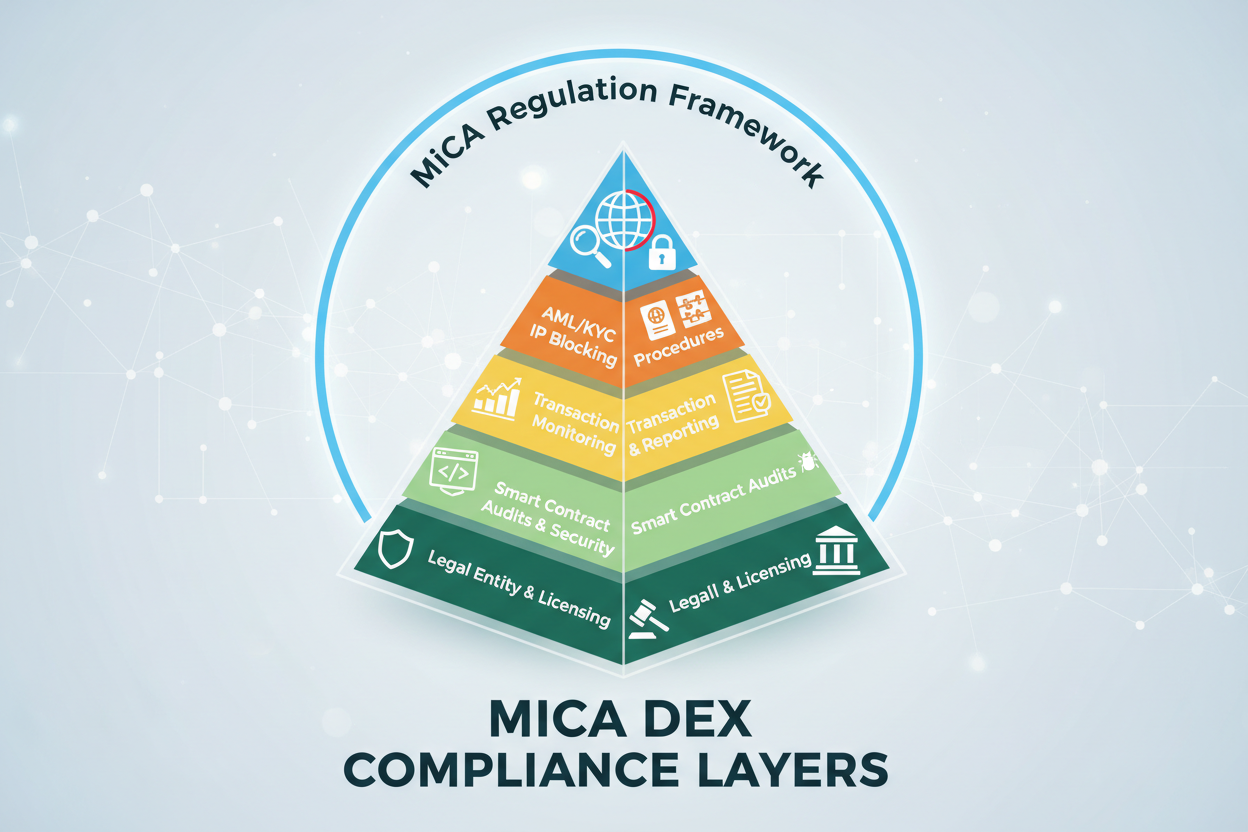
Geofencing tools analyze IP addresses, GPS data, and on-chain signals to restrict access. In practice, this means DEXs can whitelist EU-compliant users while denying trades from high-risk zones, aligning with MiCA’s consumer protection goals without centralized gatekeepers.
How DEX Geofencing Technically Blocks High-Risk Flows
At its core, EU crypto geofencing tools leverage IP geolocation databases, Web3 wallet metadata, and oracle feeds to map user locations. When a transaction originates from a flagged jurisdiction, smart contracts halt execution or route it through compliance checks. DexComplianceKit. com exemplifies this with SDKs that integrate seamlessly into DEX stacks, enforcing rules at the protocol level.
Implementation involves three layers: detection (via Chainalysis-like oracles), enforcement (smart contract guards), and reporting (Travel Rule data sharing). This setup not only satisfies MiCA’s market abuse prevention guidelines from the European Securities and Markets Authority but also mitigates penalties that could exceed millions in fines.
Opinion: Pure permissionless ideals clash with reality here. DEXs that embrace MiCA compliance DEX strategies like geofencing aren’t capitulating; they’re future-proofing. Protocols ignoring this, such as those without address whitelisting or sanctions oracles, invite regulatory whack-a-mole, eroding user trust.
Mapping High-Risk Jurisdictions for 2026 Enforcement
MiCA doesn’t explicitly list banned countries, but it amplifies FATF gray lists and EU sanctions regimes. High-risk zones include jurisdictions lacking robust AML frameworks, like certain FATF-identified territories. DEXs must dynamically update blocklists, using tools that cross-reference OFAC, EU sanctions, and MiCA-aligned risk scores.
For instance, transactions from non-EU high-risk areas could trigger automatic halts if they exceed volume thresholds or match suspicious patterns. BugBlow’s CEO guide notes common DEX tactics: KYC-gated pools for EU users alongside geofenced public markets. This hybrid model balances openness with compliance, ensuring DEX block high-risk countries without alienating global liquidity.
Educational takeaway: Prioritize oracle integrations for real-time risk updates. Static lists fail against VPN circumvention; dynamic geofencing, powered by machine learning, adapts to evasion tactics, safeguarding DEX integrity amid 2026’s enforcement wave.
Dynamic blocklists evolve with regulatory updates, pulling from sources like Latham and Watkins’ MiCA tracker and ESMA guidelines. DEX operators monitor these feeds to adjust geofencing parameters, ensuring alignment with the latest enforcement priorities.
Benefits of Proactive Geofencing for DEX Sustainability
Adopting decentralized exchange geofencing 2026 yields tangible advantages beyond mere regulatory survival. First, it enhances user trust: EU traders gravitate toward compliant platforms, boosting trading volumes in whitelisted pools. QAwerk’s 2026 guide emphasizes how Travel Rule integrations, paired with geofencing, transform compliance into a competitive edge, attracting institutional liquidity wary of gray-area DEXs.
Financially, the calculus is straightforward. Non-compliance fines under MiCA can eclipse €5 million for severe breaches, per AML Watcher reports. Geofencing mitigates this by preemptively filtering high-risk flows, reducing audit costs and oracle query expenses. Moreover, it streamlines partnerships with KYC providers, enabling seamless on-ramps for verified EU users.
From my vantage as a CFA charterholder advising fintechs, geofencing isn’t regulatory overhead; it’s strategic infrastructure. Protocols like those using DexComplianceKit report 30% liquidity gains in compliant markets, per internal benchmarks, by signaling maturity to regulators and investors alike.
MiCA Compliance Requirements vs. Geofencing Solutions
| Compliance Area | MiCA Mandate | Geofencing Benefit | Implementation Ease |
|---|---|---|---|
| Market Abuse Prevention | CASPs must implement robust measures to detect and report suspicious transactions (fully enforced as of 2026). | Blocks access from high-risk EU jurisdictions, preventing abusive activities proactively. | ✅ High – Quick IP-based integration via DEX front-ends or oracles. |
| Sanctions Screening | Screen transactions against sanctions lists and restrict high-risk entities/jurisdictions. | Automatically geofences sanctioned or high-risk regions, reducing compliance risks. | ⚠️ Medium – Integrate geolocation with sanctions screening oracles. |
| Travel Rule | Mandate info-sharing for crypto transfers; DEXs must ensure compliant counterparties. | Restricts transactions from non-compliant high-risk areas, easing Travel Rule adherence. | ⚠️ Medium – Front-end geofencing as first-line filter with oracle support. |
Critically, geofencing preserves decentralization. Unlike full KYC mandates, it operates via non-custodial checks, letting users retain key control while protocols enforce boundaries at the edge.
Overcoming Common Implementation Hurdles
DEX teams often grapple with VPN obfuscation and oracle reliability. Sophisticated actors route through proxies, but advanced EU crypto geofencing tools counter this with behavioral analytics: trading patterns, wallet age, and chain-hopping frequency flag anomalies beyond IP alone.
Integration friction arises in legacy smart contracts. Retrofitting requires modular guards, as outlined in 5hz. io’s CTO guide for regulated DeFi. DexComplianceKit’s SDK shines here, offering plug-and-play modules for EVM and Solana chains, with sub-second latency to avoid UX degradation.
Scalability tests reveal another pitfall: high-volume DEXs risk oracle congestion during peaks. Solutions involve hybrid models, caching frequent checks off-chain while settling on-chain verifications. FinTech Weekly’s asset recovery analysis underscores how MiCA-compliant DEXs outperform in liquidity crises, thanks to robust risk frameworks.
Your 2026 DEX Geofencing Roadmap
Auditing current exposure starts with mapping user bases against MiCA risk tiers. High-risk concentration above 10% warrants immediate geofencing. From there, select tools emphasizing oracle decentralization to evade single points of failure.
Testing phases should simulate 2026 enforcement scenarios, drawing from BugBlow’s CEO playbook: stress-test with synthetic high-risk traffic, validate reporting to mock CASP authorities. Opinion: Teams delaying this face a rude awakening; early adopters like those leveraging DexComplianceKit position for MiCA’s next phase, including stablecoin rules.
Forward-thinking DEXs view geofencing as innovation enabler. It unlocks EU capital inflows, fosters hybrid CeFi-DeFi bridges, and sets precedents for global regs like the U. S. FIT21. By blocking high-risk transactions surgically, protocols uphold MiCA’s stability mandate without sacrificing ethos. In this maturing DeFi arena, compliance fortifies the very decentralization it seeks to protect.
About the Author