
The 2026 regulatory landscape for decentralized exchanges
The era of regulatory ambiguity for decentralized exchanges (DEXs) has ended. In 2026, the operational reality for DEX compliance is defined by the transition from theoretical uncertainty to active enforcement. This shift is driven by the implementation of the Markets in Crypto-Assets (MiCA) regulation in the European Union and a recalibrated enforcement posture from the U.S. Securities and Exchange Commission (SEC).
MiCA imposes strict obligations on virtual asset service providers (VASPs) and, by extension, the gateways that facilitate access to decentralized protocols. For DEX operators, this means that the "code is law" defense no longer shields operations from local compliance requirements. The framework demands rigorous anti-money laundering (AML) checks, sanctions screening, and transparent reporting mechanisms that challenge the foundational anonymity of many DeFi protocols.
Simultaneously, U.S. enforcement priorities have shifted. While the SEC has removed crypto from its explicit 2026 examination priorities list, focusing instead on broader cybersecurity and market integrity, the legal risk remains acute. The absence of a specific exam priority does not equate to deregulation; rather, it signals a pivot toward high-impact enforcement actions against entities that fail to register or comply with existing securities laws. This creates a fragmented global landscape where DEXs must navigate conflicting jurisdictional demands.
The industry is currently testing compliance under new frameworks for the first time, balancing decentralized sovereignty with the necessity of local regulatory adherence.
This high-stakes environment requires DEXs to adopt on-chain KYC solutions and sophisticated compliance tooling. The cost of non-compliance has risen sharply, with potential penalties including delisting from fiat on-ramps, substantial fines, and operational shutdowns. As global oversight intensifies, the ability to demonstrate regulatory compliance has become a core component of DEX viability and user trust.
MiCA obligations and the Travel Rule for DeFi
The EU’s Markets in Crypto-Assets (MiCA) regulation fundamentally alters the compliance landscape for decentralized exchanges. Under MiCA, the distinction between a purely decentralized protocol and a regulated entity hinges on the concept of the Virtual Asset Service Provider (VASP). If a DEX’s governance structure or operational controls allow a specific entity to influence asset custody or transaction routing, that entity may be classified as a VASP. This classification triggers mandatory registration, capital requirements, and strict adherence to anti-money laundering (AML) directives. The regulation does not exempt code from scrutiny; it targets the human operators behind the code.
Compounding this is the Financial Action Task Force (FATF) Travel Rule, which mandates that virtual asset service providers share originator and beneficiary information for transactions exceeding €1,000. For DeFi, this creates a significant technical hurdle. Unlike centralized exchanges (CEXs), which have established centralized databases for Know Your Customer (KYC) data, DEXs operate on distributed ledgers. Implementing the Travel Rule requires integrating off-chain identity verification into on-chain transactions without compromising the pseudonymous nature of the blockchain. This often involves the use of zero-knowledge proofs or secure off-chain messaging protocols to transmit required data between VASPs.
The divergence in compliance obligations between centralized and decentralized platforms is stark. While CEXs bear the full brunt of direct regulatory oversight and data storage liabilities, DEXs face pressure to implement "compliant layers" or gated access points to satisfy MiCA requirements. This shift is pushing many DEX developers toward hybrid models, where the core trading engine remains decentralized, but user onboarding and transaction monitoring occur in a regulated environment.
| Feature | Centralized Exchange (CEX) | Decentralized Exchange (DEX) |
|---|---|---|
| VASP Classification | Explicitly classified as VASP | Conditional; depends on governance/control |
| KYC Implementation | Centralized database, mandatory | Optional or integrated via third-party SDKs |
| Travel Rule Compliance | Direct data sharing between VASPs | Requires off-chain messaging or ZK-proofs |
| Regulatory Liability | High; direct enforcement target | Lower; focused on front-end operators |
The path to compliance for DeFi is not merely technical but structural. Platforms must design their architecture to allow for regulatory intervention where required, such as freezing addresses linked to sanctioned entities, while maintaining the benefits of decentralization. This balance is critical for MiCA compliance, as the regulation aims to protect consumers without stifling innovation. DEXs that fail to adapt risk being blocked from EU markets or facing severe penalties for operating as unregistered VASPs. The trend is clear: the era of unregulated DeFi in the EU is ending, replaced by a framework where compliance is baked into the protocol design."
SEC enforcement trends and US market access
The US regulatory landscape for decentralized exchanges has shifted from broad enforcement actions to targeted compliance requirements. In 2026, the SEC removed crypto from its primary exam priorities, refocusing on cybersecurity and market integrity. This pivot signals a move away from blanket prohibitions toward structured oversight of specific market participants.
Despite this shift, US users face significant friction. Decentralized platforms increasingly implement geofencing and compliance layers to avoid direct confrontation with US authorities. This creates a fragmented experience where access depends on jurisdiction rather than protocol design. The debate continues over whether these measures protect investors or restrict financial freedom.
Market activity persists despite regulatory noise. Traders adapt by navigating compliance barriers or using alternative access methods. The following chart illustrates BTC/USDT volume trends, reflecting how market activity responds to regulatory developments.
For those navigating these complexities, understanding the tools and resources available is essential. The following products may assist in managing compliance and security needs.

![[Upgraded] AURSINC NanoVNA-H Vector Network Analyzer 9KHz -1.5GHz Latest HW V3.7 HF VHF UHF Antenna Analyzer, Measuring S Parameters, SWR, Phase, Delay, Smith Chart](https://m.media-amazon.com/images/I/71mMIQqxWHL._AC_UY654_QL65_.jpg)

As an Amazon Associate, we may earn from qualifying purchases.
On-chain KYC solutions and identity verification
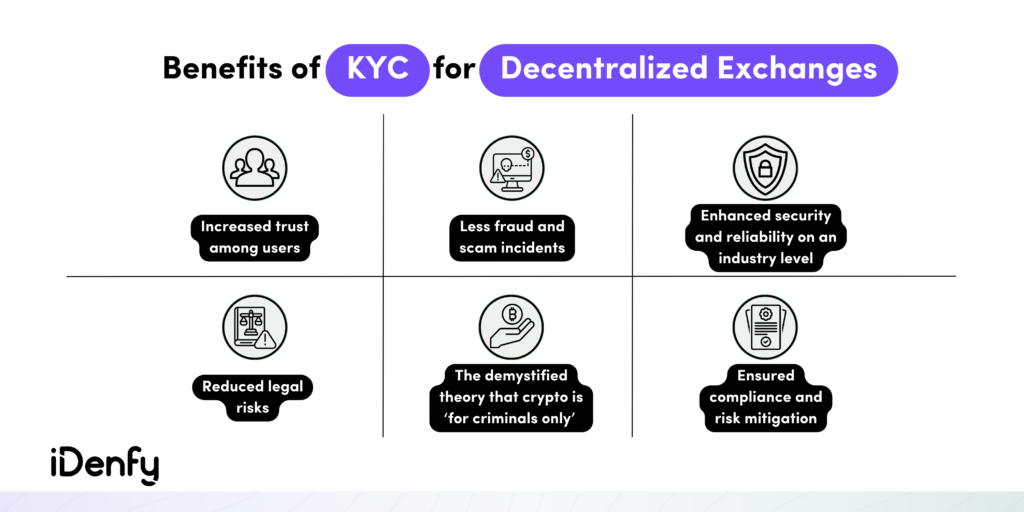
Decentralized exchanges are transitioning from passive protocol operators to active compliance entities. This shift is driven by the EU’s Markets in Crypto-Assets (MiCA) regulation and evolving SEC enforcement expectations, which increasingly treat DEX interfaces as the point of regulatory liability. The challenge lies in integrating identity verification without centralizing custody or user data.
The solution is moving identity checks off-chain and onto the blockchain as verifiable credentials. Instead of storing personal data in a central database, DEXs now rely on zero-knowledge proofs (ZKPs) and decentralized identifiers (DIDs). This allows users to prove they are not on a sanctions list or meet age requirements without revealing their name, address, or passport number.
Users submit identity documents to a trusted verifier (e.g., a government agency or licensed KYC provider). The verifier issues a signed credential or attestation on-chain, confirming the user’s status without exposing raw data.
The user’s wallet generates a zero-knowledge proof using their private key and the attestation. This cryptographic proof demonstrates compliance (e.g., "not on OFAC list") without revealing the underlying identity information to the DEX or other users.
The DEX’s smart contract validates the ZKP against a registry of trusted verifiers. If the proof is valid, the user gains access to compliant trading pairs. If invalid, the interface restricts certain functions, effectively enforcing regulatory boundaries at the protocol level.
This architecture allows DEXs to comply with MiCA’s Travel Rule and AML directives while preserving the core promise of decentralization. Users retain control of their keys and data, but the protocol can now legally operate in jurisdictions that require know-your-customer checks. As regulatory pressure mounts, this model is becoming the standard for any DEX aiming for institutional adoption.
Building a compliant DEX infrastructure
Developers must move beyond abstract governance to implement concrete compliance layers. The 2026 regulatory environment, shaped by MiCA’s stablecoin provisions and evolving SEC enforcement, requires infrastructure that can enforce restrictions at the protocol level. This is not optional; it is a prerequisite for market access.
Smart Contract Modifications
The first layer of defense involves modifying core smart contracts to support regulatory requirements. This includes implementing allowlists for specific jurisdictions and integrating on-chain KYC verification modules. Contracts must be designed to pause trading or restrict withdrawals in response to sanctions lists or court orders. Without these built-in controls, a DEX remains vulnerable to immediate regulatory action.
Backend Monitoring and Analytics
On-chain data alone is insufficient for compliance. Operators need robust backend systems that integrate blockchain analytics providers to monitor transaction patterns. These systems must flag suspicious activities, such as layering or mixing, in real-time. Automated alerts allow teams to freeze assets or report suspicious activity to authorities, satisfying the Travel Rule and anti-money laundering (AML) obligations.
Governance and Incident Response
Compliance is not static. Governance frameworks must include clear protocols for responding to regulatory inquiries and security incidents. This involves maintaining immutable logs of all compliance-related actions and having a legal team ready to interpret new guidance. Regular audits of both code and compliance procedures ensure that the infrastructure remains aligned with shifting legal standards.
Frequently asked questions about DEX regulation
The regulatory landscape for decentralized exchanges is shifting rapidly as MiCA enforcement and SEC actions evolve. Understanding how these changes impact compliance obligations and market dynamics is essential for operators and investors navigating the 2026 environment.
While regulatory clarity improves, market uncertainty remains. Operators should monitor official guidance from the SEC and EU regulators to ensure ongoing compliance with evolving standards.
No comments yet. Be the first to share your thoughts!