
The 2026 regulatory shift for decentralized exchanges
The regulatory environment for decentralized exchanges (DEXs) has undergone a fundamental restructuring in 2026. What was once treated as an unregulated gray area is now a structured compliance landscape, driven primarily by the European Union’s Markets in Crypto-Assets (MiCA) regulation and a global trend toward stricter enforcement. While the U.S. Securities and Exchange Commission (SEC) has deprioritized dedicated crypto-asset examinations in its fiscal 2026 priorities, signaling a shift in Washington’s approach, the operational reality for DEX teams remains high-stakes. The era of total anonymity is effectively over, replaced by a demand for accountability across the entire value chain.
The shift is not merely theoretical; it is operational. DEX teams are now explicitly accountable for anti-money laundering protocols, know-your-customer verification, transaction monitoring, and sanctioned wallet filtering. This responsibility extends beyond the code itself to include jurisdictional compliance and front-end service management. The distinction between the "decentralized" protocol and the "centralized" access points is becoming legally significant. Regulators are increasingly targeting the interfaces and issuers that facilitate user interaction with on-chain assets, even if the underlying smart contracts remain permissionless.
Key takeaway: Direct enforcement against purely on-chain DEX smart contracts has remained relatively limited, but the gray area is narrowing. Front-end services, aggregators, and token issuers are increasingly targeted by regulators.
This regulatory tightening creates a complex compliance environment for global operators. MiCA sets a high bar for transparency and reserve requirements, particularly for stablecoin issuers, which indirectly impacts DEX liquidity and trading pairs. As jurisdictions align their frameworks, DEXs must manage a patchwork of requirements that vary by region. The result is a market where compliance is no longer optional but a core component of product design and risk management. Teams that fail to adapt to these new standards face not only legal exposure but also loss of access to traditional financial rails and user trust.
MiCA mandates and the end of anonymity
The Markets in Crypto-Assets (MiCA) regulation fundamentally shifts the operational baseline for decentralized exchanges in the European Union. By classifying crypto-asset service providers (CASPs) under strict licensing and conduct rules, MiCA effectively dismantles the assumption that on-chain activity can remain entirely unmonitored. For institutional capital and cross-border flows, the era of pure anonymity is closing, replaced by a framework where digital asset movements are subject to the same scrutiny as traditional fiat transfers.
Central to this shift is the integration of the "Travel Rule" into decentralized infrastructure. While MiCA does not explicitly name every technical protocol, its requirements for transaction monitoring, sanctions filtering, and anti-money laundering compliance force DEX operators to implement identity verification layers. This means that before assets can be reliably routed through compliant liquidity pools, participants must often undergo identity checks. The result is a hybrid model where the permissionless nature of the blockchain is constrained by the identity requirements of the off-ramps and on-ramps it connects to.
This regulatory pressure creates a divergence in market behavior. Institutional players, bound by fiduciary duties and compliance mandates, are increasingly favoring platforms that can demonstrate adherence to MiCA standards. According to industry analysis, centralized entities like Coinbase are currently viewed as the "cleanest" publicly traded options for compliance-heavy users, highlighting the trust deficit facing unregulated DEXs in the EU market. As DEX teams face accountability for anti-money laundering failures and sanctioned wallet interactions, the technical architecture of these platforms must evolve to support traceability without compromising the core utility of self-custody.
The implication is not the death of decentralization, but its maturation into a regulated utility. DEXs that fail to adapt to MiCA’s transparency demands risk exclusion from European institutional capital. Conversely, those that successfully integrate compliance tools—such as real-time transaction monitoring and jurisdictional filtering—will likely capture the growing volume of cross-border digital asset flows seeking legal certainty.


As an Amazon Associate, we may earn from qualifying purchases.
On-chain KYC and geofencing tools
Decentralized exchanges are increasingly integrating on-chain identity verification and geofencing to address the complexities of the 2026 regulatory landscape. These technical solutions allow platforms to enforce anti-money laundering and know-your-customer requirements without centralizing user custody. By filtering transactions at the protocol level, DEXs can restrict access from sanctioned jurisdictions while maintaining the self-custody model that defines decentralized finance.
On-chain KYC typically relies on verifiable credentials or decentralized identifiers (DIDs). Users prove their identity through zero-knowledge proofs or by holding a verified token in their wallet. This approach allows the protocol to confirm compliance status without exposing sensitive personal data on the public ledger. Approximately 90% of compliant exchanges now require some form of KYC, shifting the industry away from the purely anonymous ethos of its early days.
Geofencing tools complement identity verification by restricting trading based on geographic location. These tools analyze transaction metadata and IP addresses to block access from high-risk jurisdictions. This dual-layer approach ensures that DEXs can operate within legal boundaries while offering global access to compliant users.
| Feature | Traditional CEX KYC | On-Chain DEX KYC |
|---|---|---|
| Data Storage | Centralized databases | Decentralized identifiers |
| Custody | Centralized | Self-custody |
| Verification | Manual review | Automated smart contracts |
| Privacy | Low (full data exposure) | High (zero-knowledge proofs) |
The integration of these tools represents a significant shift in the DEX ecosystem. As regulatory pressure mounts, platforms that fail to implement robust compliance measures risk exclusion from major markets. The following chart illustrates the recent volatility in the crypto market, highlighting the importance of stable, compliant trading venues.
While the U.S. SEC has reportedly dropped dedicated crypto-assets from its 2026 examination priorities, global regulators remain vigilant. DEXs must remain agile, adapting to evolving standards in the EU, Asia, and beyond. The goal is not to eliminate decentralization but to ensure it operates within a framework that protects users and prevents illicit activity.
Cex versus dex compliance choices that change the plan
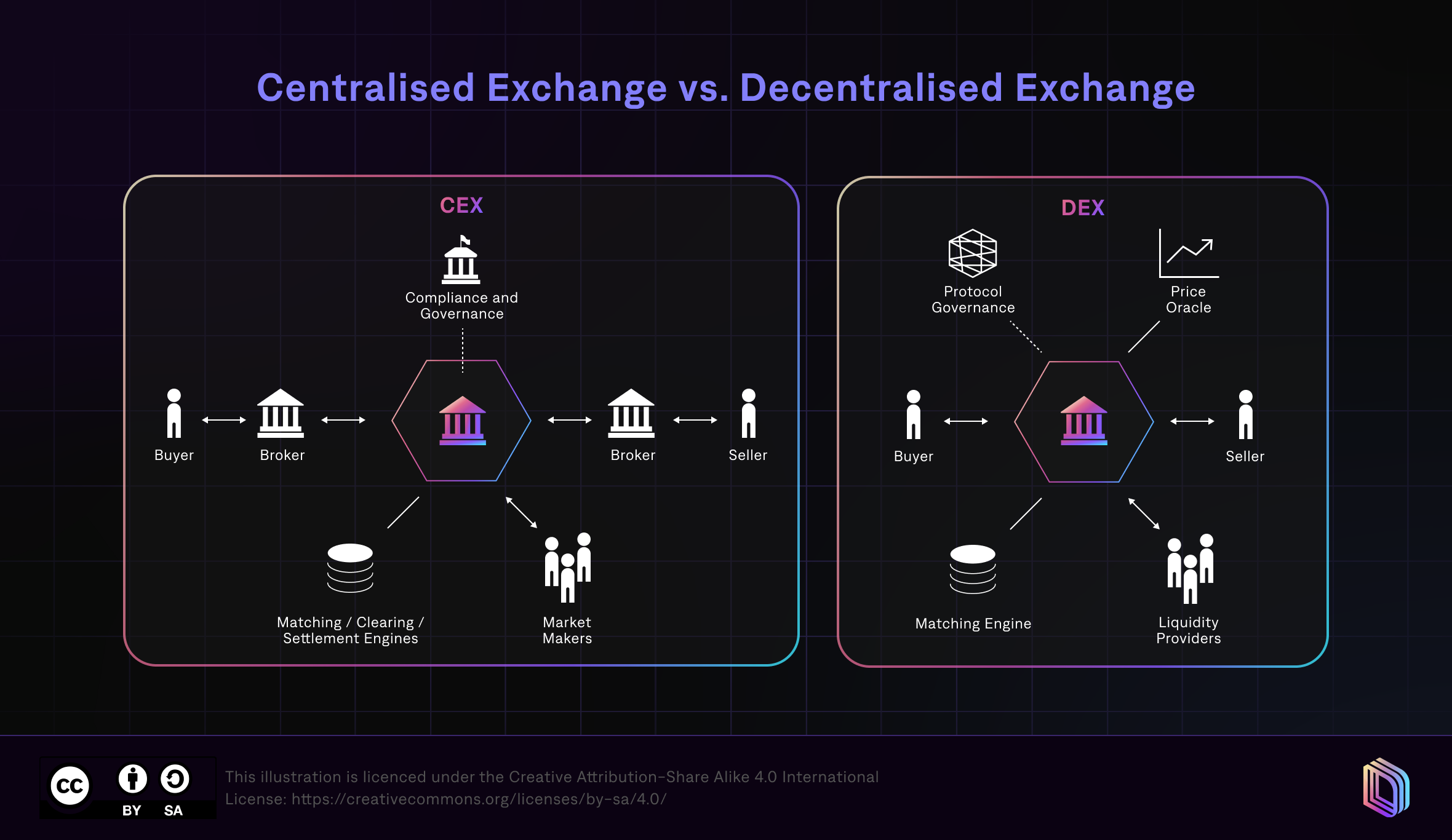
The 2026 regulatory landscape under MiCA has solidified a clear bifurcation in the crypto market. Centralized exchanges (CEX) operate as regulated financial intermediaries, while decentralized exchanges (DEX) function as permissionless protocol layers. For institutional and retail participants, the choice between these models dictates not only user experience but also the allocation of legal liability.
Compliance Burdens and KYC
CEXs bear the primary regulatory burden. Under MiCA, these entities must implement rigorous anti-money laundering and know-your-customer frameworks. Approximately 90% of CEXs now enforce full identity verification before allowing withdrawals or high-volume trading. This creates a compliant but friction-heavy environment. In contrast, DEXs typically operate without mandatory KYC, allowing users to retain self-custody of their assets. However, this anonymity attracts regulatory scrutiny, particularly regarding the enforcement of travel rules on protocol-level transactions.
User Experience and Control
The tradeoff between convenience and control is stark. CEXs offer a streamlined interface similar to traditional banking, with customer support and asset recovery options. Coinbase remains a prominent example of a "clean" publicly traded player that bridges this gap for beginners. DEXs, however, require users to manage their own private keys and interact with smart contracts. While this offers greater privacy and censorship resistance, it also places the entire burden of security on the user. A single error in transaction signing or a vulnerability in a smart contract can result in irreversible loss.
Legal Liability and Risk
Legal liability shifts depending on the venue. On a CEX, the platform is often liable for security breaches and regulatory non-compliance, offering a layer of institutional protection. On a DEX, the code is law; users assume all risk for smart contract failures, low liquidity, or high slippage. The SEC’s 2026 priorities have shifted away from aggressive crypto enforcement in favor of broader market stability, but this does not exempt DEX operators from potential liability if they are deemed to be operating as unregistered securities exchanges.
| Feature | CEX | DEX | Primary Risk |
|---|---|---|---|
| KYC Requirement | Mandatory | Optional/None | Privacy vs. Compliance |
| Asset Custody | Custodial | Self-Custody | Counterparty vs. Smart Contract |
| Regulatory Liability | Platform Liability | User Liability | Legal Action vs. Financial Loss |
| Transaction Finality | Reversible (Limited) | Irreversible | Fraud vs. Error |
The decision to trade on a CEX or DEX in 2026 ultimately hinges on the user's risk tolerance and regulatory requirements. CEXs provide a safer, more compliant environment suitable for mainstream adoption, while DEXs offer autonomy and privacy at the cost of increased operational risk.
U.S. Enforcement and Global Fragmentation
The U.S. regulatory landscape for decentralized exchanges is defined by a sharp disconnect between domestic enforcement priorities and global market access. In fiscal 2026, the Securities and Exchange Commission (SEC) removed the dedicated crypto-assets section from its Division of Examinations priorities list, signaling a shift toward a more accommodating stance on digital assets [src-serp-8]. This change suggests that while the aggressive litigation phase may be cooling, the underlying legal ambiguity remains.
Despite the SEC's shifting focus, direct enforcement against purely on-chain DEX smart contracts has historically been limited, though that gray area is narrowing [src-serp-3]. U.S. traders currently face a complex gap: they can access global DEX liquidity without domestic KYC, but they do so outside the protective framework of U.S. law. This creates a high-stakes environment where users bear the full burden of compliance and risk.
The fragmentation is further complicated by emerging hybrid models. Some platforms are introducing permissioned trading environments that embed compliance directly into the protocol, such as the Permissioned DEX on the XRP Ledger, which aims to balance institutional access with decentralization [src-serp-8]. For U.S. participants, this means the choice is no longer just between centralized exchanges and anonymous DEXs, but between regulated on-ramps and unregulated global liquidity pools.
Compliance checklist for DEX operators
Operating a decentralized exchange in 2026 requires shifting from passive protocol maintenance to active regulatory defense. Under MiCA and evolving global standards, DEX operators are now held accountable for anti-money laundering, KYC, transaction monitoring, and jurisdictional restrictions. Failure to implement these controls exposes the protocol to significant legal risk and potential delisting from regulated on-ramps.
The following steps outline the mandatory compliance infrastructure required for 2026 operations.
Deploy automated tools to scan transactions in real-time. This system must flag suspicious patterns, such as rapid layering or interactions with known illicit addresses, before they are confirmed on-chain.
Block or flag interactions with addresses listed on OFAC, EU, or UN sanctions lists. This filtering must occur at the smart contract level or via a pre-trade API check to prevent the protocol from facilitating prohibited transfers.
Restrict access to the DEX interface for users in prohibited jurisdictions. While the core protocol may be global, the frontend and API layers must enforce geo-blocks to comply with local licensing requirements, such as those under MiCA in the EU.
While retail swaps may remain permissionless, any operation involving large volumes, OTC desks, or institutional liquidity providers must require verified identity checks. This aligns with the Travel Rule and prevents the protocol from being used for large-scale money laundering.
Keep immutable records of compliance decisions, including blocked transactions and flagged users. These logs are essential for responding to regulatory inquiries and demonstrating due diligence in the event of an enforcement action.
Adhering to this checklist is not optional. As regulatory frameworks tighten, the distinction between "code is law" and legal liability is disappearing. Operators must prioritize these compliance layers to ensure the long-term viability of their platforms.
No comments yet. Be the first to share your thoughts!