
DEX Compliance 2026: SEC Enforcement and Global Regulatory Shifts
The era of self-regulation for decentralized exchanges is ending. By 2026, DEX compliance constraints have shifted from theoretical debates to active enforcement, driven by the SEC’s aggressive stance on unregistered securities trading and global regulators closing loopholes that previously allowed anonymous trading.
In the past, DEXs operated under the assumption that code was law and that non-custodial architectures shielded them from traditional financial oversight. Today, that shield is gone. The SEC’s enforcement actions against platforms like Uniswap have made it clear that the legal definition of an "exchange" now includes decentralized protocols that facilitate the trading of unregistered securities. This means DEX developers and operators are no longer invisible; they are now accountable for Anti-Money Laundering (AML), Know Your Customer (KYC), transaction monitoring, and sanctioned wallet filtering.
This regulatory shift has fundamentally altered the competitive landscape. Centralized exchanges (CEXs) like Coinbase and Kraken, while facing their own compliance burdens, are better positioned to handle the new rules because they already have established legal frameworks and KYC infrastructure. DEXs, however, must now integrate identity verification and transaction screening tools without breaking their core value proposition of user sovereignty. The result is a hybrid model where "permissionless" trading is increasingly gated by compliance checks, often invisible to the user until a transaction is flagged.
The practical implication for users and developers is that privacy and compliance are now in direct tension. While DEXs still offer better privacy than CEXs due to non-custodial wallet structures, the regulatory pressure is forcing DEXs to implement on-chain analytics and wallet screening. This means that while your wallet acts as your account, your transaction history is no longer anonymous to regulators. The tradeoff is clear: you gain security and control, but you lose the ability to trade without scrutiny. For institutions, this creates a complex decision matrix. If you are an institutional trader, the compliance burden of a DEX is now comparable to a CEX, but the legal recourse is weaker. For retail users, the choice is between the convenience and legal protection of a CEX and the autonomy, but higher regulatory risk, of a DEX.
The market is already responding to these shifts. The price of major DEX tokens and the trading volume on leading decentralized protocols reflect investor uncertainty about the long-term viability of unregulated DEX models. As the SEC continues to define the boundaries of crypto regulation, DEXs that fail to adapt will face enforcement actions, while those that integrate compliance seamlessly will gain institutional trust. The future of DEXs is not about escaping regulation, but about embedding it into the code.
Compliance Models That Change the Plan
Navigating SEC enforcement and global regulatory shifts requires DEX operators to choose between pure anonymity and operational legitimacy. The landscape has shifted from a regulatory vacuum to a framework where compliance is no longer optional for sustainable operations. Teams must now balance user privacy against the burden of KYC/AML checks and transaction monitoring.
Core Compliance Factors
The primary tradeoff centers on identity verification. Fully anonymous DEXs offer superior privacy but face immediate legal risk under current SEC interpretations, which often classify unregistered securities trading as a violation. Conversely, DEXs integrating KYC protocols reduce regulatory exposure but compromise decentralization for many users.
Another critical factor is jurisdictional alignment. Operators must determine if they qualify for safe harbor provisions, such as satisfying cumulative conditions like objective transaction routing and non-custodial asset handling. Failure to meet these criteria can trigger enforcement actions, regardless of the protocol's decentralized architecture.
Comparison of Compliance Models
The table below compares the two dominant models emerging in 2026. Each approach carries distinct risks regarding regulatory scrutiny and user adoption.
| Model | User Privacy | Regulatory Risk | User Adoption |
|---|---|---|---|
| Fully Anonymous | Maximum | High (SEC Enforcement Target) | Niche/Privacy-focused |
| KYC-Integrated | Limited (Verified Users) | Low (Compliant Structure) | Broad/Institutional |
| Hybrid (Geofenced) | Moderate (Region-Dependent) | Medium (Complex Jurisdiction) | Moderate |
Decision Framework
Choose a fully anonymous model only if targeting niche privacy users and accepting high legal vulnerability. Opt for a KYC-integrated approach if prioritizing longevity, institutional partnerships, and defense against SEC enforcement. Hybrid models offer a middle ground but require complex geofencing infrastructure to restrict access from prohibited jurisdictions.
Choose the Right DEX Compliance Path
Selecting a decentralized exchange model in 2026 requires balancing regulatory exposure against operational autonomy. The choice is no longer just technical; it is a legal strategy. Teams must decide how much control they are willing to surrender to comply with evolving SEC enforcement and global AML standards.
1. Self-Custody Only (Non-Custodial)
This model keeps users in control of their private keys. While it minimizes direct liability for the protocol, it does not eliminate risk. Regulators increasingly scrutinize the front-end interface and the team behind the code. If the interface facilitates transactions with sanctioned wallets, the team may still face enforcement actions.
2. KYC-Gated Non-Custodial
By integrating identity verification at the entry point, teams can filter out high-risk actors before they enter the protocol. This approach significantly reduces regulatory pressure by demonstrating proactive compliance. However, it adds friction to the user experience and requires robust data privacy measures to protect user information.
3. Hybrid Custodial Model
Some platforms offer a hybrid approach where certain features or jurisdictions require custodial controls. This allows teams to serve regulated markets while maintaining a decentralized core. The tradeoff is increased operational complexity and higher security requirements, as the platform becomes a target for both hackers and regulators.
4. Jurisdiction-Specific Compliance
Operating in specific legal jurisdictions allows teams to tailor their compliance efforts to local laws. This might involve registering as a Money Services Business (MSB) or obtaining specific licenses. While this provides legal clarity in those regions, it fragments the global user base and increases administrative overhead.
5. Automated On-Chain Compliance
Newer protocols embed compliance directly into smart contracts using oracle-based sanctions lists and transaction monitoring. This reduces human error and provides real-time adherence to regulatory updates. However, it requires significant technical expertise and careful auditing to avoid introducing vulnerabilities or censoring legitimate transactions.

Evaluate your team's technical capacity and legal resources. Determine which compliance model aligns with your long-term goals and risk tolerance. Consider the potential impact of SEC enforcement on your specific structure.
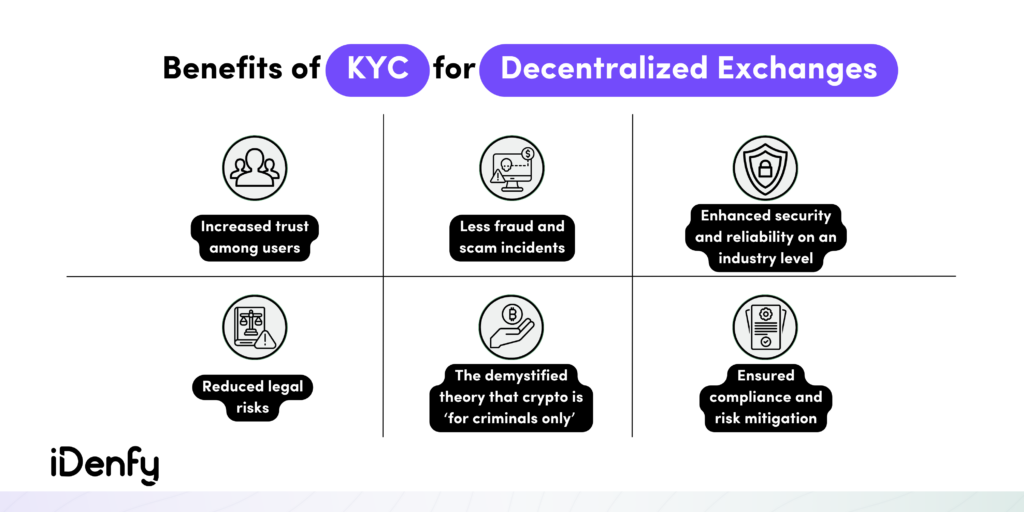
Regardless of the model, implement basic AML and KYC checks. Use sanctioned wallet filtering to prevent transactions with known bad actors. This is the baseline expectation for any DEX operating in 2026.

Stay updated on global regulatory changes. Adapt your compliance framework as new laws emerge. Engage with legal experts to ensure ongoing adherence to SEC and international standards.
| Model | Regulatory Risk | User Friction | Tech Complexity |
|---|---|---|---|
| Self-Custody | Medium | Low | Low |
| KYC-Gated | Low | Medium | Medium |
| Hybrid Custodial | Low | High | High |
| Jurisdiction-Specific | Variable | Medium | High |
| Automated On-Chain | Low | Low | Very High |


As an Amazon Associate, we may earn from qualifying purchases.
The Weak Options in 2026 DEX Compliance
As regulatory pressure mounts, several "compliance" approaches are failing. These weak options create false security, exposing projects to SEC enforcement or silent bans.
1. The "No-KYC" Myth Many DEXs claim zero identity checks. This is a liability trap. The SEC now treats protocol developers as money transmitters if they enable sanctioned transactions. Ignoring AML isn't privacy; it's negligence.
2. Obfuscated Governance Projects hiding behind anonymous multisigs or shell companies cannot satisfy jurisdictional compliance requirements. When regulators demand transaction monitoring logs, ghost teams vanish. This leaves users with frozen assets and no recourse.
3. Static Smart Contract Audits A one-time audit is not compliance. It is a snapshot. As DeFi strategies evolve, new vulnerabilities emerge. Relying solely on past audit reports ignores the dynamic nature of on-chain risk and sanctioned wallet interactions.
The SEC’s 2026 enforcement trend targets these gaps. Projects must implement real-time sanction filtering and transparent governance structures. Weak compliance is no longer a feature; it is a fatal flaw.
Next Steps for DEX Compliance
The regulatory landscape for decentralized exchanges has shifted from ambiguity to enforcement. In 2026, the primary question is no longer if a DEX must comply, but how it can do so without sacrificing user sovereignty.
Is a DEX exempt from KYC and AML regulations?
No. While early DEXs operated under the assumption that code is law, regulators now hold development teams and front-end operators accountable for Anti-Money Laundering (AML) and Know Your Customer (KYC) requirements. DEX teams are now expected to implement sanctioned wallet filtering, transaction monitoring, and jurisdictional compliance checks to avoid severe penalties.
Can I operate a DEX without a license in the United States?
Operating a DEX in the U.S. without proper licensing is increasingly risky. To qualify for safe harbors, providers must satisfy cumulative conditions, including objective and verifiable transaction routing and no custody of user assets. Failure to meet these standards often triggers classification as a Money Services Business (MSB), requiring registration with FinCEN.
How do I ensure my DEX stays compliant with global standards?
Compliance requires a multi-layered framework. Beyond basic KYC, operators must integrate blockchain analytics for real-time transaction monitoring and adhere to the Travel Rule for cross-border transfers. This means building governance structures that can respond to regulatory changes in multiple jurisdictions simultaneously.
What happens if my DEX facilitates illegal transactions?
Regulators are targeting the infrastructure rather than just the users. If a DEX fails to implement adequate sanctioned wallet filtering or transaction monitoring, it can face enforcement actions, asset freezes, or shutdowns. The cost of non-compliance now far outweighs the benefits of ignoring regulatory oversight.
No comments yet. Be the first to share your thoughts!